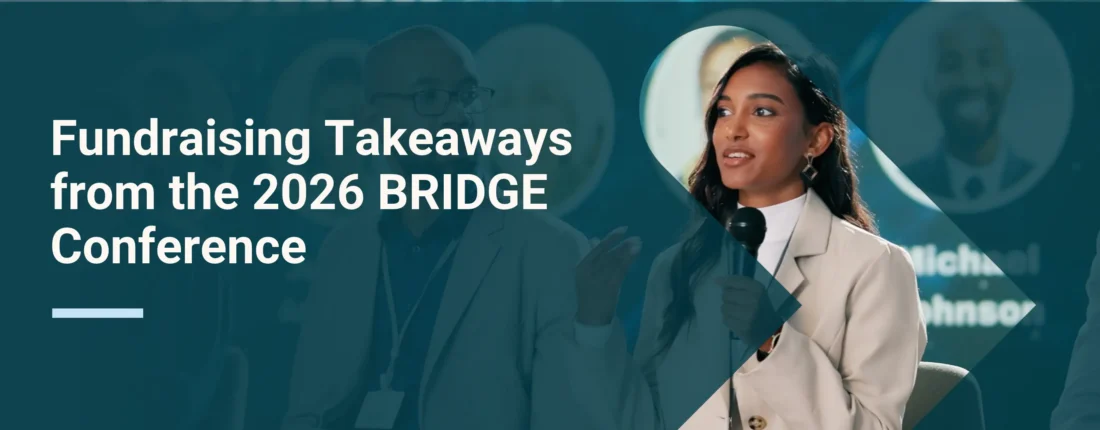
Fundraising Takeaways from the 2026 Bridge Conference
- What I Learned at the 2026 Bridge Conference
- 1. Donor-Advised Funds (DAFs) Aren’t a Major-Donor Niche Anymore
- 2. Trust Is the Entry Fee for Alternative Giving, Not the Reward for It
- 3. DAF Sustainers Are Rare, and Worth Building a Program Around Anyway
- 4. The Donor Journey to Alternative Giving Is Rarely a Straight Line
- 5. Small Copy Changes on a CTA Button Still Move Real Revenue
- 6. Strong Imagery on Your Donation Page Isn’t Decoration, It’s Conversion
- 7. Mid-Level Donor Acquisition Works Better in Unexpected Places
- 8. A Smaller, More Engaged List Will Outperform a Bigger, Colder One
- 9. Deliverability Is Infrastructure, Not a Checklist You Run Once
- 10. Write Your SMS from Scratch, and Let Two-Way Replies Do the Work
What I Learned at the 2026 Bridge Conference
Every year, the Bridge to Integrated Marketing & Fundraising Conference brings together practitioners who are running the tests, not just talking about them. This year, the sharpest lessons showed up in three places: how organizations are handling Donor-Advised Funds, how email programs are fighting to stay in the inbox, and how mobile is finally becoming a real two-way channel instead of a broadcast tool.
Here are 10 lessons worth stealing for your own digital fundraising program.
1. Donor-Advised Funds (DAFs) Aren’t a Major-Donor Niche Anymore
DAF accounts skew smaller than most fundraising teams assume, which means DAF messaging belongs in the mid-level program, not only the major-gifts playbook.
Kate Rhodes (International Rescue Committee) and Lindsay Marino Long (Faircom NY), presenting “From Appeals to Alliances: A New Playbook for DAFs & Alternative Giving,” pointed out a stat that should reset how most teams think about DAFs: 68% of DAF accounts hold balances under $100,000, and 49% are under $50,000.
These aren’t exclusively six- and seven-figure donors parking assets with a wealth advisor. A meaningful share of DAF holders look like your existing mid-level file. If your organization treats DAF messaging as a major-gifts-only conversation, you’re likely missing donors who are already sitting on this vehicle.
2. Trust Is the Entry Fee for Alternative Giving, Not the Reward for It
Internal education has to happen before a DAF campaign launches, because a single slow or incorrect answer can undo the trust that took months to build.
Rhodes and Long were direct on this point: if a donor calls with a DAF or Qualified Charitable Distribution (QCD) question and your team gives a slow or incorrect answer, that trust doesn’t come back easily. Internal education has to happen before the campaign launches, not after the first confused phone call.
Promoting these vehicles paid off when the groundwork was in place: QCD revenue climbed 55%, and DAF giving grew 39% during year-end pushes. But the campaign only works if whoever answers the call can speak to it confidently.
3. DAF Sustainers Are Rare, and Worth Building a Program Around Anyway
Low volume isn’t the same as low value. DAF recurring gifts are far less common than standard sustainer gifts, but they carry outsized weight in the revenue mix.
Rhodes and Long also flagged that DAF recurring gifts remain a small share of the sustainer file, but the gift sizes are far larger than standard credit card recurring gifts: averaging $246 versus $85, and climbing as high as $1,275 versus $113 in peak year-end months.
4. The Donor Journey to Alternative Giving Is Rarely a Straight Line
A 30-month case study showed that segmentation, predictive modeling, and timely personal outreach, not any single touchpoint, moved a donor toward a DAF and a legacy gift.
The session’s strongest moment was a 30-month case study nicknamed “Joan’s Journey.” A $200 gift after an earthquake became 18 months of small, steady donations, then a DAF postcard that prompted a phone call, then an estate planning conversation, then a dip in activity that a DAF-likelihood model caught in time to trigger the right appeal at the right moment.
No single touchpoint did that work. It took strategic segmentation, a model flagging the right moment, and staff who knew when to show up personally rather than sending another email.
5. Small Copy Changes on a CTA Button Still Move Real Revenue
A single button copy test outperformed its control by 46%, proving that matching gift campaigns still have room to test even after the match is secured.
In “30 WOW! Ideas That Wowed Us! (2026 Edition),” Mwosi Swenson (Mal Warwick Donordigital), Allison Porter (Avalon Consulting Group), and Tiffany Neill (Lautman Maska Neill & Company) shared a test where the CTA “Make 2x the Difference” outperformed the control “Match My Gift” by 46%.
Matching gift campaigns get treated as a set-it-and-forget-it tactic once the match itself is secured. This test is a reminder that the button copy sitting on top of that match is still worth testing on its own.

6. Strong Imagery on Your Donation Page Isn’t Decoration, It’s Conversion
Adding relevant imagery to a donation page drove a 24% lift in conversion, making it one of the cheapest fixes available to most fundraising teams.
The same session pointed to a straightforward test: adding strong, relevant imagery to online donation pages drove a 24% increase in conversion rates.
If your donation page still looks like a form with a logo on it, this is the cheapest fix on the list.
7. Mid-Level Donor Acquisition Works Better in Unexpected Places
Display ads on high-authority, contextually relevant sites outperformed the usual acquisition channels for bringing in new $500+ mid-level donors.
Swenson, Porter, and Neill also highlighted display ad placements on contextually relevant, high-authority sites–think Forbes or a niche publication tied to your mission–as an effective way to acquire new $500+ mid-level donors.
Most digital acquisition budgets chase the same handful of platforms. This lesson is about finding the sites your mid-level donor is already reading and showing up there instead.
8. A Smaller, More Engaged List Will Outperform a Bigger, Colder One
Restricting sends to a smaller, recently active cohort protects deliverability in a way that mailing the full list never will.
In “Email Fundraising & The (Seemingly) Immovable Force of Deliverability,” Genevieve Shaw (MKDM), Meg Pickarski (Statue of Liberty & Ellis Island Foundation), and Lauren Swan (Rails to Trails Conservancy) walked through what they called a “Pulse” segmentation model: instead of emailing the full file, successful programs restrict sends to a smaller cohort of recently active, engaged subscribers.
This runs against the instinct to email everyone on the list every time. But deliverability rewards restraint. Inboxes and spam filters are watching engagement patterns, and a program that mails its full list indiscriminately trains providers to distrust it.
9. Deliverability Is Infrastructure, Not a Checklist You Run Once
SPF, DKIM, DMARC, list hygiene, and domain warming need an owner and ongoing attention, not a one-time setup.
Shaw, Pickarski, and Swan were clear that SPF, DKIM, and DMARC configuration, list validation, double opt-ins, and one-click unsubscribes aren’t a project you finish. High-volume senders need ongoing domain warming, dedicated subdomains to isolate promotional traffic, and continuous list hygiene.
Treat deliverability like you’d treat your CRM data: something that degrades if nobody owns it, and something worth assigning real ownership to instead of hoping it takes care of itself.
10. Write Your SMS from Scratch, and Let Two-Way Replies Do the Work
SMS copy pulled from email underperforms, while a human voice and reply-driven asks pushed engagement rates far above standard click asks.
In “Making Waves with Mobile,” Lloyd Colter (Banter Messaging), Jess Kiesa (Oceana), and Maya Lozinsky (Oceana) put it plainly: design for the channel, not the inbox. SMS copy pulled from an email campaign reads as exactly that, and donors notice.
The payoff for getting this right showed up in the numbers. Standard click asks saw a 1.5% click rate, while “response asks” that invited a reply drove a 5.2% reply rate. Oceana built this on a consistent, human staff voice (“Mira’s voice” internally) after migrating from a generic one-way broadcast platform to a system built for two-way conversation and segmentation.
What This Means for Your Program
- DAF and alternative giving messaging belongs in your mid-level program, not just your major gifts playbook.
- Internal training has to happen before external promotion, whether that’s DAFs or a new mobile platform.
- Small, testable changes (a button, an image, a segmentation rule) are still producing some of the biggest lifts in the room.
- Deliverability and channel-specific writing are ongoing disciplines, not one-time setup tasks.
If your team is looking to put any of these into practice, from DAF strategy to email deliverability to mobile program builds, that’s the kind of work we do at Media Cause. Reach out and let us know how we can help you meet your goals.