Why Creator-Driven Content Is the #1 Nonprofit Social Trend for 2026
For nonprofits planning their 2026 social strategy, one shift matters more than any platform update or algorithm change: creators have moved from a tactical add-on to core infrastructure.
Last year, the conversations we had with prospective clients made the shift obvious. Nonprofits weren’t asking whether to work with creators. They were asking how to integrate creators across fundraising, brand, advocacy, and events as a sustained growth lever, not a one-off campaign line item.
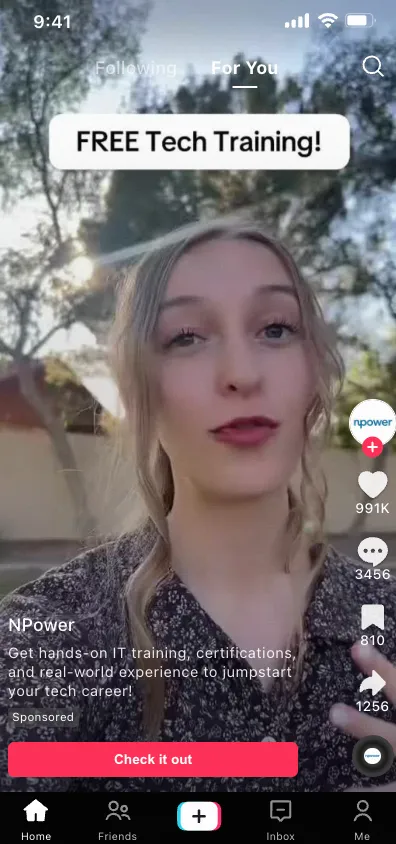
Our 2025 work spanned a wide range of creator strategies, from a precision influencer campaign reaching 66K Americans for the Partnership for Public Service, to creator activations with NPower, to programs we run through our own in-house advocacy solution, Rallystarter. Here’s what that work taught us, and what we’re carrying into 2026.
 Creator content holds up as paid media
When creator-made content gets repurposed into paid placements, it consistently outperforms traditional brand creative.
We saw it with Common Sense Media‘s, where creators were part of the paid mix and their content beat other assets. We saw it again with iCivics, where personality-driven posts and UGC-style content outperformed polished institutional content across the board. The pattern is consistent enough that we now treat creator content as a paid media input by default, not just an organic play.
The takeaway for nonprofit marketers: if you’re producing creator content, build the paid usage rights into the partnership from day one.
The definition of “influencer” needs to widen
With Eyecare4Kids, we ran a small-budget test in influencer partnerships. Our first instinct was familiar territory: Utah-based family and parenting creators like The Yeagers, whose partnership drove real donations.
But the bigger unlock came when we pushed the client to think beyond lifestyle creators and bring in subject-matter professionals. Optometrist Dr. Alexa Hecht wasn’t flashy or overly produced. She was credible. For a mission rooted in vision care, that credibility translated.
For nonprofits in 2026, the most useful “influencers” are often the practitioners, researchers, advocates, and community members closest to the issue. Audience trust beats audience size.
Lower-lift formats lower the barrier
Not every client is ready to launch a full influencer program. For those teams, we’ve seen real traction with lighter-weight formats like the TikTok Creator Challenge, which invites participation from a wider creator pool without the overhead of formal contracts and shoots.
These formats are useful for nonprofits running pilots, testing creative directions, or working with limited budget and bandwidth. They generate creator energy and community participation at a fraction of the cost of a traditional partnership.
Creator strategy now extends past social
Influence doesn’t just live on Instagram or TikTok anymore. With IPPF, we leaned into audio platforms, which surfaced a category of creator most nonprofits aren’t yet thinking about: the podcast host.
Long-form audio gives mission-driven storytelling room to breathe in ways short-form social can’t. For organizations whose work involves nuance, advocacy, or lived experience, podcast partnerships are worth a serious look in 2026 planning.
What this means for your 2026 strategy
The throughline across every example above, including clients who weren’t running formal influencer programs, is that audiences engage with people, not institutions. Faces and stories outperform graphics and polish. Personality outperforms production value.
That has implications well beyond your creator budget. It should shape how your in-house team approaches social content, video, even how leadership shows up in your owned channels. Creators are modeling a content style that nonprofits can and should adopt for themselves.
Want help building creator marketing into your 2026 plan, whether that’s a full program or a first pilot? Get in touch with Media Cause.
Want more from Tiffany on social strategy for nonprofits? Follow Socially Savvy on Substack.